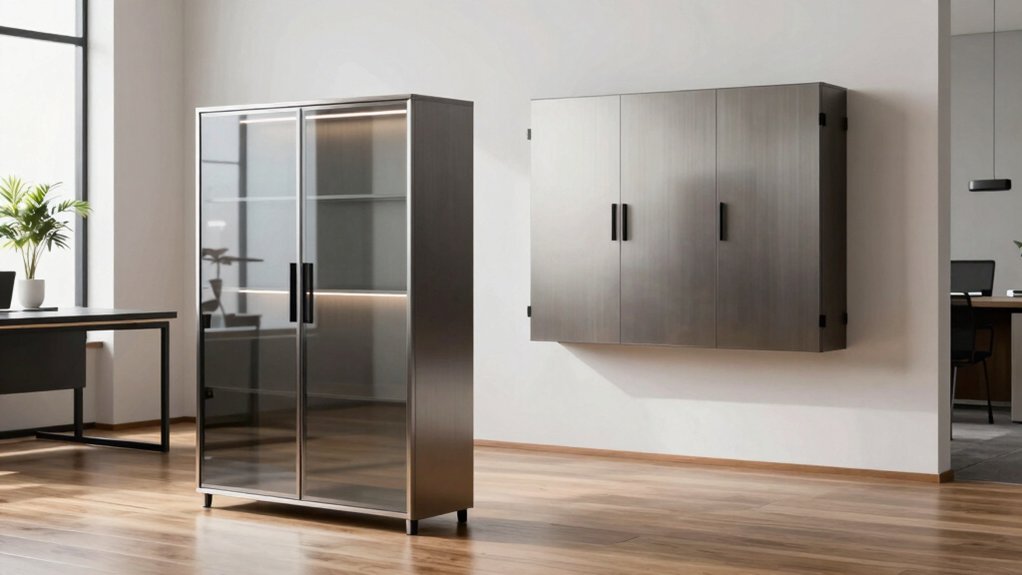
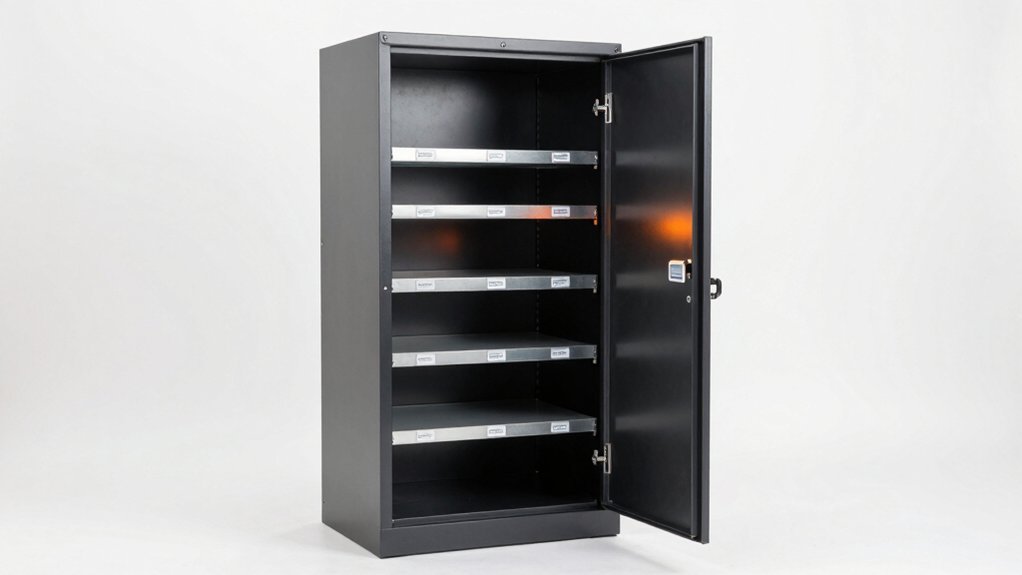
You’ll find that steel cabinets—especially cold‑rolled Q235 or stainless steel with powder‑coated finishes—outlast every other option, delivering 15‑25 years of service under heavy loads and high moisture. Aluminum follows, offering excellent rust resistance, while solid hardwood and high‑grade plywood rank next for durability. MDF and particleboard fall behind due to sagging and moisture sensitivity. If you keep going, you’ll uncover how each material’s strengths and trade‑offs affect long‑term performance.
Key Factors That Define Cabinet Longevity
When you evaluate cabinet longevity, the most decisive factor is how the material handles moisture, impact, structural integrity, thickness, and construction details. You’ll weight moisture sealing first: plywood’s layered grain resists warping, while aluminum and powder‑coated steel stay rust‑free even when scratched. Solid wood needs sealants to block humidity‑driven expansion, and plastic or resin absorb moisture without degradation. Next, assess load distribution: steel frames support heavy loads without flexing, and plywood with a TFL surface spreads stress, reducing dents. Plywood’s cross‑grain construction and solid hardwood’s grain strength provide sag resistance, whereas particleboard sags under weight. Finally, prioritize panels at least three‑quarters inch thick, mortise‑and‑tenon joints, and edge‑banding to structural integrity and long‑term performance. Consider also the load rating of each cabinet to ensure it meets your intended use. Selecting a material with a high impact resistance rating further safeguards against everyday wear and tear. Understanding the fire classification of materials helps you meet safety standards and reduce risk.
How to Evaluate Cabinet Durability Before Buying
If you want to gauge a cabinet’s durability before purchase, start by systematically inspecting the structural details, material specifications, hardware quality, interior features, and finish integrity. Examine drawer boxes for solid‑wood dovetail joinery and confirm face‑frame hardwoods—Alder, Cherry, Hickory, Maple, Oak—are used. Verify box panels are at least ½‑inch thick, preferably ¾‑inch, and that plywood, not particleboard, forms the core, ensuring moisture resistance and cost efficiency. Test soft‑close hinges and full‑extension slides for smooth operation, simulating 35,000 cycles. Look for melamine interiors, I‑beams, and high‑quality sealants that block humidity. Finally, assess installation complexity; well‑engineered cabinets reduce labor risk and extend lifespan, even when budget wood options are considered. Consider the coating thickness to ensure long‑term protection against wear and corrosion.

Organizes a variety of kitchen items behind closed doors.

Pinewood Build: If you spend a lot of time in the kitchen, you will want beautiful natural woodwork that offers tough and quality firm walls. This kitchen cabinet has a hearty pinewood build with varnish-treated surfaces.

REAL SOLID PINE CONSTRUCTION: Frame, doors, and shelves are 100% solid pine with the weight and feel of real furniture. An engineered back panel adds rigidity so the cabinet stays square through years of loading, unloading, and moves.
Why Steel Cabinets Outperform Others in Strength and Longevity
Although many storage solutions claim durability, steel cabinets consistently outshine alternatives because their load‑bearing capacity, corrosion resistance, and engineered construction translate directly into measurable strength and lifespan. You’ll find that a 12‑gauge stainless steel frame supports up to 1,000 lb without warping, while individual drawers hold 225 lb and shelves 400 lb, all with negligible fatigue. Double‑walled construction and precision‑formed parts raise rigidity, preventing buckling under heavy loads. Steel corrosion resistance, enhanced by powder‑coated or galvanized finishes, eliminates rust even in coastal or chemical‑plant environments, extending service life to 15–25 years. Lower gauge numbers mean thicker metal, so opting for a lower gauge reduces dents and dings. The data shows steel’s superior strength, durability, and cost‑effectiveness over time. Metal storage cabinets also provide enhanced security features such as lockable doors and reinforced panels, protecting valuable assets and ensuring compliance with industry regulations. Selecting the appropriate load capacity ensures the cabinet meets specific operational demands.

Material - Stainless Steel


Complete Set: Comes with 2 pairs of ear gauges in size 1/2 inch (12mm) for a total of 4 pieces
Why Solid Wood Still Beats the Competition for Long‑Lasting Cabinets
Why do solid‑wood cabinets still outlast most alternatives? You’ll see that hardwoods such as oak, maple, and cherry consistently hit 50‑plus‑year lifespans when you apply proper sealing and grain‑proofing. Data shows oak’s natural grain grain delivers impact resistance, while maple’s dense structure tolerates daily wear without cracking. When you sand and refinish dents, the grain grain restores original strength, extending service life far beyond laminate or particle‑board. Moisture‑control studies reveal that a well‑finished surface prevents warping and rot, even in humid climates. Maintenance logs confirm that occasional dusting and prompt spill drying preserve structural integrity. Consequently, solid‑wood cabinets retain aesthetic value, support eco‑friendly sourcing, and offer systematic repairability unmatched by other materials. Their lightweight durability makes them ideal for both residential and commercial settings.
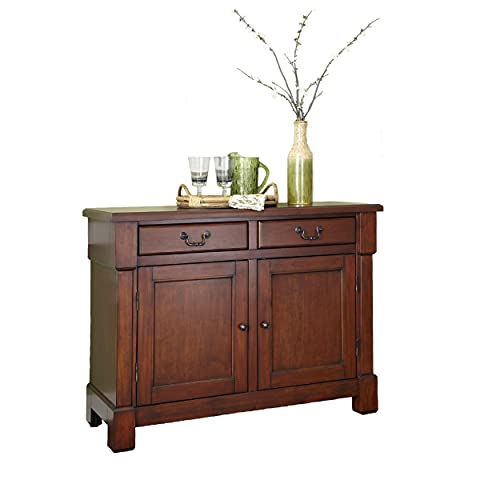
The strength of mahogany makes it durable and the beauty stands the test of time.

44" W × 34" H × 18" D — 2 DOORS WITH ADJUSTABLE SHELVES + 1 DRAWER — Generous storage footprint fits dishware, glassware, table linens, pantry overflow, or entryway essentials. Adjustable shelf positions let you customize spacing for tall pitchers, short stacks of dishes, or storage bins
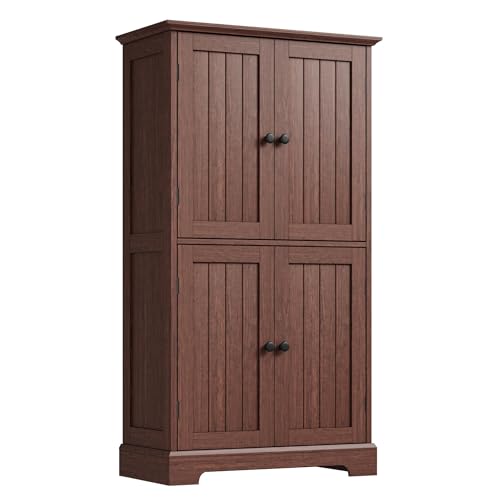
【Ample Storage Space】 Featuring upper and lower compartments with 4 doors, this bathroom cabinet provides sufficient space for towels, toiletries, cosmetics, or kitchen essentials, keeping your bathrooms, living rooms, or kitchens tidy and organized
How Aluminum Keeps Cabinets Strong in Moisture‑Heavy Environments
Because aluminum’s non‑porous surface blocks water absorption, cabinets made from this metal stay flat and intact even in the most humidity‑laden kitchens, basements, and outdoor patios. You’ll notice that the material’s Moisture‑proof sealing prevents swelling, warping, and mold growth, because water cannot infiltrate the panels. Data show that aluminum rust resistance remains above 95 % after 5,000 exposure cycles, outpacing stainless steel and wood composites. Powder‑coated finishes add UV protection while preserving corrosion immunity, so structural strength holds at 0.8‑1 mm thicknesses. The sealed construction eliminates cracks, and the alloy’s rigidity resists denting under repeated moisture stress. Consequently, cabinets retain load‑bearing capacity without rot, rot, or degradation in any damp environment. The non‑organic nature of aluminium also prevents insect infestation, ensuring long‑term durability. Properly sealed cabinets can also meet fire‑rating standards for high‑temperature safety. Selecting the appropriate material density further optimizes strength‑to‑weight ratio for varied load requirements.
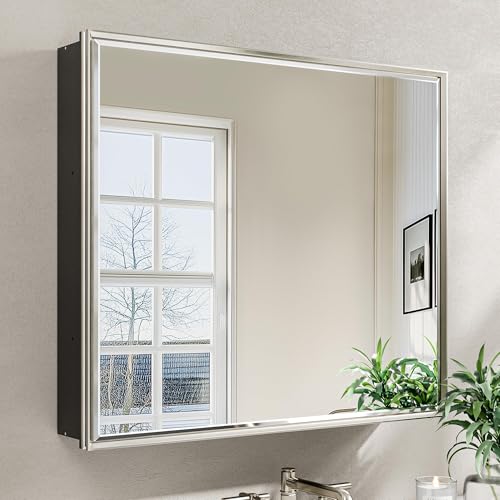
【Pre-assembled & Reversible Design】No assembly required! This mirror medicine cabinet comes fully assembled. The cabinet is almost the same size as the door,ensuring ample storage space while adding decorative appeal to the wall. Whether surface-mounted or recessed, it looks equally attractive. The reversible door allows for left or right opening, offering flexibility and convenience!

【Pre-assembled & Reversible Design】No assembly required! This mirror medicine cabinet comes fully assembled. The cabinet is almost the same size as the door,ensuring ample storage space while adding decorative appeal to the wall. Whether surface-mounted or recessed, it looks equally attractive. The reversible door allows for left or right opening, offering flexibility and convenience!

【Pre-assembled & Reversible Design】No assembly required! This mirror medicine cabinet comes fully assembled. The cabinet is almost the same size as the door,ensuring ample storage space while adding decorative appeal to the wall. Whether surface-mounted or recessed, it looks equally attractive. The reversible door allows for left or right opening, offering flexibility and convenience!
Why Plywood Beats MDF and Particleboard in Engineered Durability
When you compare engineered panels, plywood consistently outperforms MDF and particleboard across strength, dimensional stability, fastener holding, and moisture resistance. Its cross‑grain reinforcement distributes loads, giving it superior bending and shearing resistance; tests show plywood carries roughly double the load of MDF and three times that of particleboard. Dimensional stability follows the same pattern: the alternating grain layers limit expansion and shrinkage, keeping cabinets square despite temperature swings, whereas MDF and particleboard swell up to 8 % with humidity changes. Fastener holding benefits from the same grain orientation, with screw pull‑out strength exceeding alternatives by 45 %. Marine‑grade moisture protection further seals the layers, preventing water ingress that would otherwise cause MDF to swell and particleboard to disintegrate. This systematic advantage translates into longer service life and fewer repairs. The evolution of storage cabinets reflects historical material innovations that have shaped modern durability standards. Their robust construction also contributes to enhanced workplace safety by reducing the risk of structural failure. Proper load assessment is essential for maintaining structural integrity over time.

MARINE-GRADE PLYWOOD DURABILITY – Forget warping MDF; our 30 inch bathroom vanity is crafted from high-quality plywood for superior moisture resistance and anti-warp performance. This moisture resistant bathroom cabinet ensures a long-lasting, resort-quality foundation that withstands high-humidity environments effortlessly.

MARINE-GRADE PLYWOOD CONSTRUCTION – Stop replacing swollen MDF cabinets. Our water resistant bathroom vanity is crafted from premium marine-grade plywood, engineered to withstand high humidity without warping or distorting. This plywood bathroom vanity 24 inch model is a lifetime investment in your home’s durability.
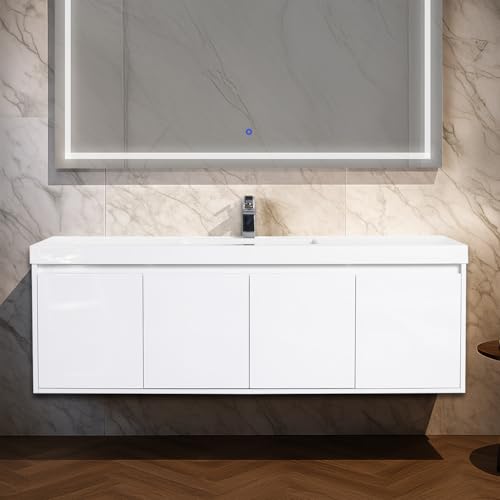
MAXIMIZE MASTER BATH STORAGE: This 60 inch bathroom vanity offers expansive counter space, perfect for luxury skincare and daily routines. The elegant single sink design transforms any master bathroom into a high-end, modern spa-style retreat.
When MDF Is a Viable Long‑Term Option (and Its Limitations)
Even though plywood dominates durability metrics, MDF can still serve as a long‑term cabinet material when it’s installed in controlled, low‑humidity environments and maintained rigorously. You’ll find that standard MDF lasts 8‑12 years in air‑conditioned spaces and averages 10‑15 years with proper care; moisture‑resistant grades push that to 12‑18 years, and exterior‑grade sealed units can reach 15‑20 years. Data show that a systematic maintenance routine—immediate spill wiping, dehumidifier use, edge protection, and regular hardware checks—adds up to 5 years of service life. MDF cost is typically lower than plywood, and an Eco‑friendly finish can reduce VOC emissions while enhancing durability. Limitations remain: sagging, warping, and swelling under high humidity, especially near windows or coastal climates, signal impending failure. For high‑traffic areas, powder coating provides superior scratch and moisture resistance. Following a proper sanding technique before painting ensures better adhesion and a smoother final appearance. Regularly checking the seal integrity helps catch early signs of moisture infiltration.
How to Rank Cabinet Materials by Expected Service Life (Cabinet Durability)
A practical way to rank cabinet materials by expected service life is to compare their durability metrics across four key dimensions—structural strength, moisture resistance, maintenance demand, and typical lifespan under normal use. First, assign scores for structural strength: steel tops Q235 cold‑rolled steel, solid hardwood, and high‑grade plywood score highest, while particleboard trails. Next, evaluate moisture resistance: aluminum and powder‑coated steel lead, followed by plywood with TFL finish, then wood, which needs proper sealing. Third, assess maintenance demand: steel and aluminum need minimal upkeep; wood requires periodic refinishing; plywood is moderate; particleboard is high. Finally, estimate typical lifespan: steel > hardwood > plywood > aluminum > laminate > particleboard. Factor in eco‑friendly sourcing and modular repairability to fine‑tune your ranking. Plastic cabinets also offer strong moisture resistance due to their non‑porous construction. In industrial settings, metal storage cabinets provide essential fire safety because of their inherent fire‑resistant properties. Proper ventilation can also mitigate mold growth within cabinets, preserving both contents and material integrity.
Pick the Right Cabinet Material for Your Needs (Cabinet Longevity)
Your material choice should reflect the specific load, moisture, and maintenance conditions you expect in the space. Evaluate load capacity first: steel (Q235, >20 gauge) tolerates heavy tools without flexing; aluminum handles moderate loads with slight flex; plywood and solid wood support substantial weight when TFL‑treated; MDF suits lighter, evenly distributed items. Next, assess moisture exposure: stainless steel and powder‑coated steel resist water, rust, and pests; aluminum excels in humid or coastal settings; marine‑grade plywood and sealed MDF offer acceptable resistance; solid wood needs sealing to avoid warping. Consider maintenance: steel and aluminum demand minimal upkeep; plywood and solid wood require periodic refinishing; MDF needs sealed finishes. Prioritize Eco‑friendly sourcing for wood and aluminum, and choose Modular assembly design to simplify installation and future reconfiguration. A well‑ventilated interior can further prevent corrosion, especially when using powder‑coated steel for high‑humidity environments. Additionally, selecting cabinets with waterproof seals enhances protection against moisture ingress in basements and outdoor areas.