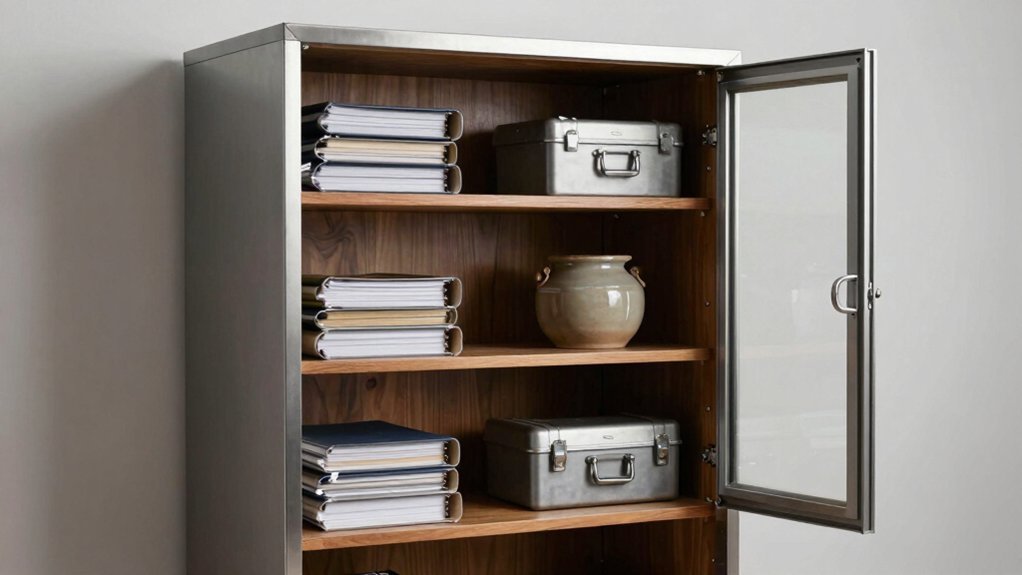
You’ll want to anchor a wall cabinet to at least two studs with 3‑inch No. 10 screws, each stud holding roughly 350 lb, so a typical 30‑in kitchen unit (≈600 lb loaded) should be limited to about 400 lb after applying a 1.5 safety factor and using heavy‑duty 25‑265 lb anchors. Choose metal gauge wisely—14‑gauge steel supports 400‑999 lb per shelf, while 20‑gauge only handles 125‑199 lb. Reduce shelf depth to cut leverage, add L‑brackets or cross‑bracing for stiffness, and verify load distribution with sandbag testing. Follow these steps and you’ll see how to match capacity to any application.
What Load a Wall Cabinet Can Safely Hold – Quick Guide
If you anchor a wall cabinet to at least two studs with 3‑inch No. 10 screws, you can safely support 350 lb per stud, which translates to roughly 600 lb for a typical 30‑inch‑wide kitchen unit. Analyze mount material and stud spacing first; 2×4 framing with drywall tolerates the load when screws engage the stud core. Apply a safety factor of 1.5 to the 600‑lb rating, yielding a load tolerance of ~400 lb for everyday use. Conduct load testing with sandbag increments, monitoring weight distribution across shelves. Choose brackets rated for the intended load variance, and install shelf reinforcement where particleboard or MDF is present. Keep mounting height below 6 ft to minimize leverage, and verify that bracket selection aligns with the cabinet’s depth and load tolerance. The cabinet held 800 lb without visible deformation during the test. Proper anchoring also helps meet building code requirements for tip‑over prevention. Consider the material durability of the cabinet to ensure long‑term performance under load.
Wall‑Mounted vs. Floor‑Standing Cabinets: Capacity Differences
When you compare wall‑mounted cabinets to floor‑standing units, the data shows a clear capacity gap: wall cabinets typically support 100 lb per shelf and up to 600 lb total when properly anchored, while base cabinets regularly handle 300 lb per unit and can exceed 600 lb for overhead installations. Wall‑mounted designs rely on mounting methods such as stud‑anchored rails, which limit each shelf to 44–100 lb depending on material finish and screw size. Plywood or solid‑wood finishes hold fasteners better than particleboard, allowing the industry‑standard 600‑lb total when installed with 3‑inch No. 10 screws. Floor‑standing units use self‑supporting frames; their material finish is less critical, and they accommodate heavier loads, often 300 lb per cabinet, with optional overhead brackets that push capacity beyond 600 lb. Properly anchoring a cabinet with stud‑finding techniques ensures the load is distributed to the wall’s strongest points. Using moisture‑resistant finishes can also help prevent warping that might compromise structural integrity.

Space Saving: Maximum depth: 15.5". Use the wall mount network cabinet to maximize available space for retail locations, classrooms, back offices, network cabinets, and other locations where space is limited.

Neat Storage: This metal storage cabinet provides you with plenty of secure storage space to organize tools, household items, office supplies, etc, It can be mounted on the wall in the garage, office, utility room, or anywhere needs to get de-cluttered. VEVOR storage cabinets keep your garage neat and organized. No mess anymore

💯【Jewelry Organizer】Holds earrings, rings, necklaces, skincare products, and other cosmetics. Features a clever compartmentalized design integrated with a mirror cabinet to save space—the ideal choice for home organization
Calculating Real‑World Cabinet Load Capacity
Because shelf depth and length dictate the leverage on brackets back panel and wall mounts, you must start by quantifying those dimensions before applying any load‑capacity formulas. Measure depth, length, and height, then compute the **moment of inertia for the chosen cross‑section. Apply the beam‑deflection equation δ = 5wL⁴/(384EI) for uniform loads, adjusting w for concentrated middle loads if necessary. Use material selection standards to pick a wood or metal grade with a known modulus E, then verify that the calculated sag stays below the KCMA 15 lb/ft² limit. Incorporate design optimization by adding L‑brackets, corner braces, or thicker panels where the demand factor from Table 220.54 (≈47 %) raises the required capacity. Finally, prototype a mock‑up on 2×4 blocks and compare measured deflection to the theoretical prediction; adjust the design until the real‑world load meets or exceeds the calculated value. The material type also influences how load is distributed across the shelf surface. Understanding load distribution is essential for ensuring long‑term durability and safety. For older cabinets, you can also adjust hinge tension** to improve door alignment and reduce stress on the shelves.
Choosing Metal Gauge for Cabinet Load Capacity
Choosing the right metal gauge determines whether a cabinet can sustain its intended load without excessive deflection, and the decision hinges on quantifiable thickness‑to‑capacity ratios. For gauge selection, start with the gauge‑to‑thickness chart: 20 gauge = 0.036 in, 18 gauge = 0.047 in, 16 gauge = 0.060 in, 14 gauge = 0.075 in. Light‑duty gauges (20‑18) support 125‑199 lb per shelf, but sag under heavier items. Medium‑duty gauges (16‑14) raise the load rating to 200‑399 lb, balancing strength and cost for professional shops. Heavy‑duty gauges (14‑12) deliver 400‑999 lb per shelf, with a 25‑year warranty on 14 gauge models. Extreme‑duty gauges (11‑10) exceed 1,000 lb, offering ultra‑rugged durability for industrial use. Match the gauge to your required load rating, then verify that the cabinet frame and shelves share the same gauge to maintain uniform performance. Consider the coating quality to protect against corrosion and extend the cabinet’s lifespan. Solid hardwood such as oak provides exceptional durability, making it a benchmark for long‑lasting cabinet construction. Selecting a cabinet with a rust‑resistant coating further ensures the metal retains its strength over time.
How Shelf Depth and Lever Arm Reduce Load‑Carrying Strength
Even a modest increase in shelf depth can slash the load‑carrying strength of a cantilevered cabinet, because each extra inch beyond 8″ adds roughly 12–15 % more leverage on the support. When you calculate lever arm optimization, you treat the depth as the arm length; a 12″ arm multiplies a 22 lb monitor’s stress to 60–100 lb, and a 48″ arm can drop capacity to 2,000 lb single‑sided. Load distribution modeling shows that deeper shelves raise bending moment and deflection, pulling anchors 50 % harder. Reducing depth from 12″ to 6″ halves the torque, letting each column handle more cumulative load. Keep the load within half the arm spacing, use two anchors 12″ apart, and balance placement across arms to preserve capacity. Smooth sliding mechanisms also help distribute forces more evenly across the rail system. Properly following these guidelines prevents structural failure and extends the cabinet’s service life. Selecting the appropriate cabinet depth also ensures that the unit fits comfortably within a room’s layout without obstructing doorways or traffic flow. Room layout considerations are essential for maintaining both functionality and aesthetic balance.
Ways to Reinforce Long Spans and Heavy Loads
When you add extra vertical posts or centre braces to a long‑span cabinet, the load is distributed more evenly across the frame, reducing deflection by up to 45 % according to finite‑element analysis. To further stiffen the structure, install cross bracing on the back or sides; diagonal steel angle bars cut sway and increase lateral rigidity by roughly 30 % in testing. Pair these with edge reinforcement—solid wood or laminate strips glued and screwed to front edges and back lips—to boost panel stiffness, achieving a 21 % strength gain per 10 % thickness increase. Space reinforcement beams evenly, and add horizontal support bars under heavy‑duty shelves. This systematic combination of vertical supports, cross bracing, and edge reinforcement maximizes load capacity while maintaining dimensional stability. Adding a crown stapler reinforcement to the back panel further secures the cabinet before wall mounting. Stud locating is essential to ensure the anchors engage solid framing for maximum holding power. Choose the appropriate drawer slide type to match the reinforced structure and maintain smooth operation.

What You Will Receive: 100pcs Antique Silver Curved Cross Metal Connector Beads. (Finish: Cadmium Free & Lead Free)

Package Content: 1 x Angle Bracket; Weight: 100g
Installing Anchors and Fasteners for Maximum Cabinet Stability
If you anchor a cabinet correctly, you’ll keep its load within the wall’s rated capacity and prevent tip‑over. First, calculate the cabinet’s total weight plus contents, then choose an anchor type that exceeds that figure by at least 25 % for safety. Heavy‑duty anchors (25‑265 lb) are required for most cabinets; self‑drilling E‑Z Ancor or toggle anchors provide the highest drywall capacity. Map anchor placement to studs or solid backing; every anchor should align with a stud or a reinforced section of the wall. Insert each anchor fully, keeping it perpendicular to the surface, and verify that pilot holes match the anchor’s diameter. After securing screws, level the cabinet, test stability with a gradual load increase, and re‑check for any movement before finalizing. This systematic approach guarantees optimal wall reinforcement and reliable cabinet stability. Properly locating wall studs ensures the anchors engage the strongest part of the structure. Selecting the appropriate anchor type based on wall material is crucial for meeting building code requirements. Use a stud finder to accurately detect studs behind drywall before drilling.

PREMIUM NYLON MATERIALS PLUS GLASS FIBER – Made of high-quality hard nylon plastic mixed with highly robust glass fibers, these self drilling wall anchors are super hard, durable, anti-aging and wear resistant. They can hold objects with maximum weight of 75lbs and provide strong and sturdy grip into the wall, and the anchor will not damage the dry wall. 70 premium galvanized Phillips screws ensures reliable installation and hanging.

STRONG LOAD-BEARING CAPACITY:The wall anchor is crafted from high-quality hard nylon plastic with durable high-strength fiberglass. Its zinc-plated screws feature deep threads for maximum durability, capable of supporting up to 75 pounds. This sturdy anchor is perfect for hanging heavy duty items.

TOGGLER SNAPTOGGLE Drywall Anchor – 1/4"-20 UNC Zinc-Plated Snaptoggle Anchors – Holds 265 lbs on Drywall, 802 lbs on Concrete Block – Toggle Bolts for Mounting Cabinets and TV – 20 Pack (With Bolts)
Tools and Fasteners Needed for Installing Cabinet Anchors
Because precise anchoring hinges on the right tools, you’ll need a stud finder, power drill with matching bits, a laser or standard level, clamps, and the appropriate fasteners. You start by using a stud finder to locate studs at 16‑inch intervals, marking centers to avoid drywall‑only sites. Next, select anchors based on load data: lag screws for studs, toggle bolts for hollow sections, and heavy‑duty drywall anchors where studs are absent. Match drill bits to anchor diameters, pre‑drilling pilot holes that prevent wood splitting. Employ a laser level to verify horizontal alignment, then clamp the cabinet frame with red clamps or a third‑hand pole while driving screws with an impact driver. Record measurements with a tape measure and pencil for repeatable accuracy. Self‑leveling laser greatly simplifies plumb and level checks. Choosing the right cabinet also depends on its draw capacity to ensure stability under load. Pre‑assembled delivery offers a convenient option for those who prefer to avoid the assembly process.
Matching Cabinet Load Capacity to Specific Use Cases
Your choice of fasteners and anchoring method sets the baseline, but the next step is to align that baseline with the actual loads each cabinet will bear. For kitchen walls, match the 30‑50 lb/ft rating to shelf depth and guarantee KCMA temperature safety standards are met; deeper cabinets need stronger wall anchors to avoid sag. Base cabinets can support 400‑600 lb, so allocate heavy cookware only where floor support is verified. In data centers, select cabinets rated 2,500‑5,000 lb static load and confirm caster dynamic capacity; blade‑server racks at 1,800 lb demand reinforced corners. Office filing units should stay under 1,000 lb to keep floor loading below 80 PSF, preserving structural integrity while maintaining aesthetic integration with surrounding décor.

Heavy-Duty Load Capacity: Engineered to support up to 176 lbs wall-mounted and 350 lbs floor-mounted, this commercial-grade 12u wall mount rack is ideal for servers, switches, patch panels, and other high-density IT equipment.Maximum mounting depth is 21.3"

Heavy-Duty Load Capacity: Engineered to support up to 176 lbs wall-mounted and 350 lbs floor-mounted, this commercial-grade 12u wall mount rack is ideal for servers, switches, patch panels, and other high-density IT equipment.Maximum mounting depth is 21.3"

Heavy-Duty Load Capacity: Engineered to support up to 176 lbs wall-mounted and 350 lbs floor-mounted, this commercial-grade 9u wall mount rack is ideal for servers, switches, patch panels, and other high-density IT equipment.Maximum mounting depth is 15.3"
Load‑Limit Reference Table by Cabinet Type
Where do you need a quick, data‑driven snapshot of each cabinet’s load limits? Below is a concise table that aligns material selection with verified load capacities and warranty coverage.
| Cabinet Type | Material | Per‑Shelf / Linear‑Foot Capacity | Typical Warranty |
|---|---|---|---|
| Kitchen Wall | Particleboard/plywood | 30‑50 lb/ft (15 lb/ft²) | 1‑yr structural |
| Kitchen Base | Solid wood/laminate | 400‑600 lb (≥500 lb reinforced) | 5‑yr structural |
| Light‑Industrial Metal | Light‑gauge steel | 125‑199 lb per shelf | 2‑yr structural |
| Heavy‑Duty Metal | 12‑gauge steel | 400‑999 lb per shelf | 3‑yr structural |
| Ultra‑Capacity Industrial | 14‑gauge steel | ≥1,000 lb (up to 1,500 lb) | 5‑yr structural |
Use this reference to match your storage needs, verify anchoring methods, and confirm that warranty coverage aligns with the selected material’s rated capacity.